
Modern enterprises often reach a point where standard configuration—the « click-not-code » promise of Salesforce—no longer supports their operational scale. When your business processes require complex multi-system architectures, custom application development, or high-volume data integrations, you need more than a consultant; you need a dedicated Salesforce development company. With Salesforce holding 20.7% of the global CRM market and serving over 150,000 companies, the demand for specialized technical talent is rising, with the number of Salesforce developers projected to grow at a CAGR of 7.2% through 2035.
What Is a Salesforce Development Company?
A Salesforce development company is a technology partner focused on building, extending, and maintaining the platform through custom code and advanced engineering. Unlike consulting firms that prioritize strategy and process mapping, development companies focus on the technical execution of your CRM roadmap.
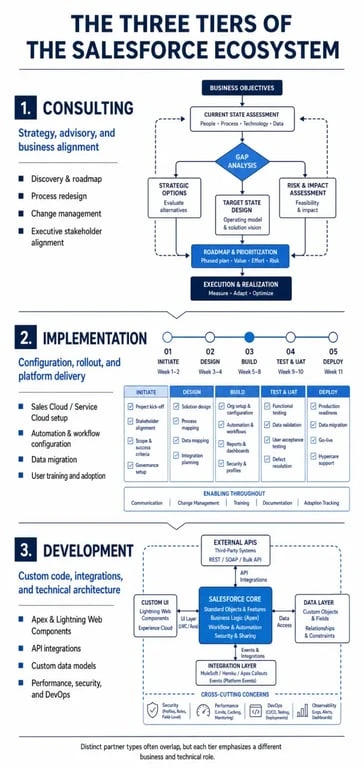
These partners are necessary when your requirements move beyond standard UI customization. Their core competencies typically include:
- Apex Programming: Developing server-side logic to handle complex business rules that standard Flows cannot manage.
- Lightning Web Components (LWC): Building responsive, high-performance front-end interfaces for a seamless user experience.
- System Integration: Connecting Salesforce to ERP, billing, marketing, or e-commerce systems via REST or SOAP APIs.
- Platform Engineering: Developing custom applications or AppExchange products that require deep knowledge of Salesforce’s underlying architecture.
Development vs. Consulting vs. Implementation Partners
Choosing the right partner requires distinguishing between the tiers of the Salesforce ecosystem. Understanding these boundaries ensures you allocate your budget toward the correct type of expertise.
Consulting Companies
These firms act as strategic architects. They excel at mapping business goals to Salesforce Clouds, such as Sales, Service, or Financial Services. They are the best choice for organizations in the early stages of digital transformation or those needing to optimize their current CRM strategy.
Implementation Partners
Typically engaged for initial deployments, these partners focus on configuration, data migration, and user training. They ensure that a new Cloud implementation is stable and adopted by staff from day one.
Development Companies
These partners are the builders. You bring them in when the architecture is defined, but the required functionality exceeds the platform’s native capabilities. They provide expertise in CI/CD maturity, code quality, and technical debt management, ensuring that your long-term roadmap remains scalable.
Key Evaluation Criteria for Your Technical Partner
Selecting a partner based on marketing claims alone is a risk. To avoid budget overruns and missed deadlines, evaluate potential firms against rigorous technical benchmarks.
Technical Depth Checklist
When interviewing a candidate, request evidence of their engineering maturity. A reliable partner should demonstrate:
- CI/CD Implementation: How do they manage code deployments? They should use automated testing and version control to prevent regression bugs.
- Middleware Expertise: For data-intensive integrations, do they have experience with middleware solutions that prevent API limit exhaustion?
- Code Quality Practices: Ask for examples of how they document code and maintain adherence to Salesforce best practices, which is vital for maintainability after the platform’s three major annual updates.
A well-developed Salesforce instance reflects the health of your internal data processes. If the underlying code is poorly structured, your CRM will reflect those inefficiencies, leading to low adoption and lost productivity. A strong development partner understands that clean code is a foundational asset that clarifies your business logic rather than obscuring it.
Services Offered by Specialized Firms
To maximize your ROI, align your project scope with the specific services these companies provide. Common engagements include:
| Service Area | Primary Benefit |
|---|---|
| Custom Salesforce Development | Solves unique business problems not addressed by out-of-the-box features. |
| Complex Integrations | Ensures data flows seamlessly between CRM and external legacy systems. |
| Data Migration & Cleaning | Eliminates bad data before it reaches your new production environment. |
| Ongoing Support | Provides maintenance and feature updates after the initial launch. |
Proof Points of Credibility
In a saturated market, filter providers based on verified data. Look for these indicators before signing a contract:
- Salesforce Partner Status: Check the Salesforce AppExchange for official listings. Status as an ISV or Consulting Partner indicates a verified relationship with Salesforce.
- Public Reviews: Utilize platforms like Clutch or GoodFirms. These sites offer objective, client-verified feedback on delivery timeliness and technical competence.
- Industry-Specific Case Studies: A partner with experience in Health Cloud or Financial Services Cloud will have pre-built solutions and compliance knowledge that a generalist agency lacks.
- Certified Experts: Ensure the team assigned to your project holds relevant certifications, such as Platform Developer I & II.
Reducing Project Risk
The success of a Salesforce project hinges on the hand-off between strategy and execution. By partnering with a firm that balances deep technical knowledge in Apex and LWC with a mature delivery methodology, you reduce the risk of wasted budgets and stalled implementations. Whether you are building an extension for AppExchange or modernizing a legacy CRM, prioritize partners who prove their expertise through documentation, certified staff, and a track record of successful, long-term support.

- Doubles réservations, agendas conflictuels : 6 réglages Calendly qui sécurisent la prise de RDV - 12 juillet 2026
- UX et SEO : la vitesse, la navigation et le contenu qui améliorent vraiment un site - 11 juillet 2026
- Duplicate content et SEO : pas toujours une pénalité, mais une visibilité qui peut chuter - 11 juillet 2026
Articles qui pourraient vous intéresser :
 Sélectionner la meilleure action en bourse : 4 ratios financiers pour fiabiliser vos choix
 Crédit à l’étranger : 10 banques européennes pour financer vos projets en tant que Français
 Pilotage stratégique : 4 leviers pour transformer vos objectifs en résultats concrets
 SAFe Scrum : 5 différences majeures avec le Scrum classique et comment réussir son passage à l’échelle